
16 Nov Outsource Clipping Path: How to Find and Vet a Reliable Image Editing Partner
Outsource Clipping Path: How to Find and Vet a Reliable Image Editing Partner
You’re spending too much time editing product photos. You need to outsource your clipping path work — but how do you find a partner who won’t eat edges, miss deadlines, or disappear when your catalog deadline hits?
Here’s how to find, vet, and choose a clipping path service that protects your brand and your conversion rate.
Step 1: Ask to See the Edges — Not Thumbnails
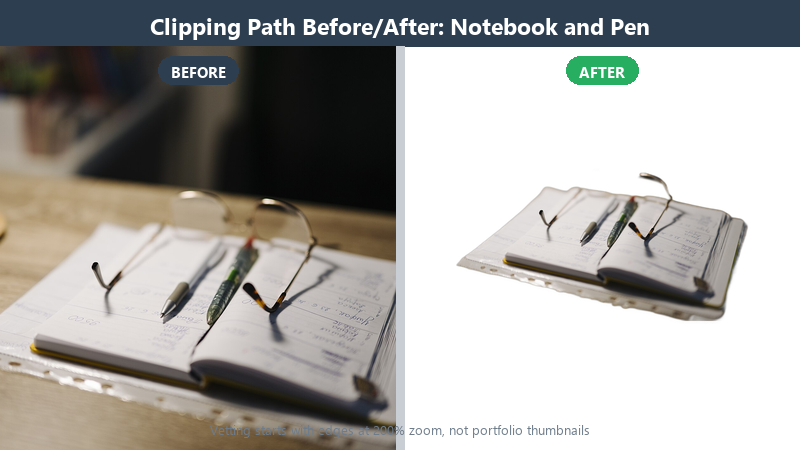
Any clipping path provider can show beautiful thumbnails. Thumbnails hide halos, jagged edges, and eaten details. Ask for hair masking and glass product images at 300% zoom. If they won’t show you the edges, they’re hiding something.
Step 2: Test With Your Brand Standard, Not Just Samples
Send your written image standard — shadow angle, white point, edge softness — and see if they can match it consistently. Good shops follow specs. Cheap shops follow their habits. One image that looks right means nothing; fifty images that match your standard means everything.
Step 3: Check the Revision Policy
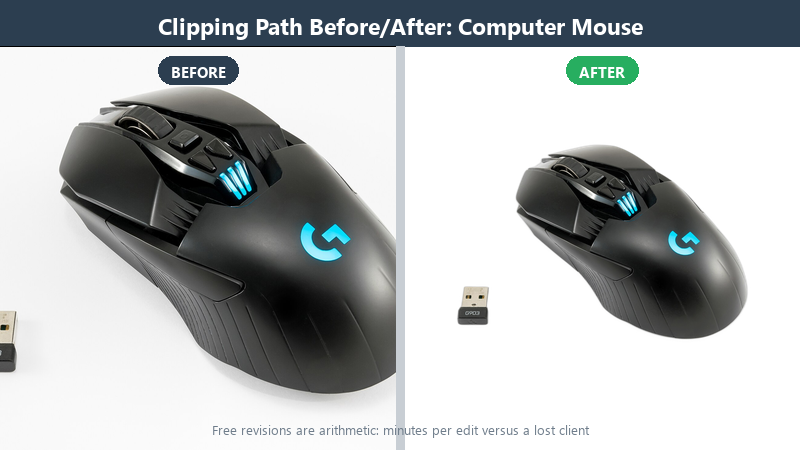
If revisions cost extra or require negotiation, the quoted price is fiction. A reliable partner revises until the image is right. Unlimited revisions sound generous; they’re actually arithmetic. The cost of one more edit round is minutes. The cost of a lost client is the entire relationship.
Step 4: Ask About Volume and Turnaround
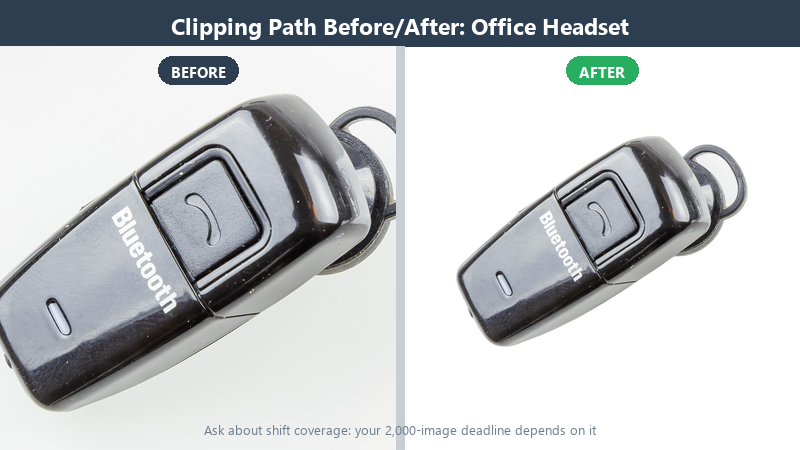
A shop that handles 20 images a week beautifully may fall apart at 2,000. Ask directly:
- What’s your capacity at peak volume?
- Do you run shift coverage for 24-hour deadlines?
- What’s your QC process?
Step 5: Start With a Free Trial
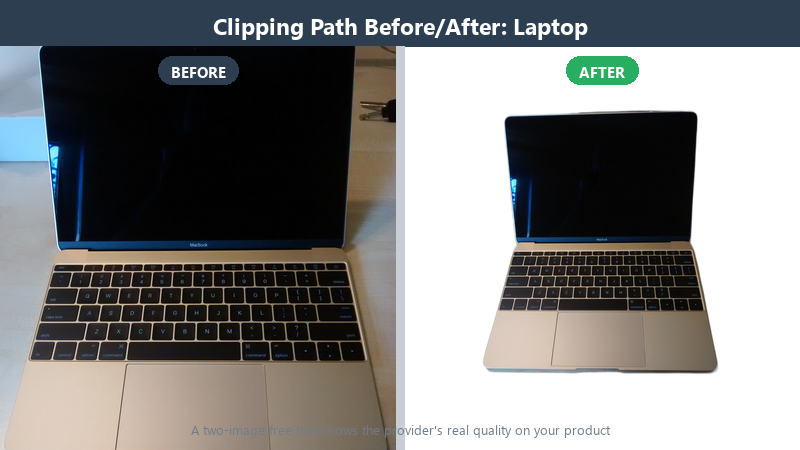
No argument about quality beats seeing work on your own product. A reputable clipping path service will clip two images free so you can compare the edges yourself. Use that trial to judge edge quality, shadow realism, and communication speed.
Red Flags to Watch For
- No published pricing (“contact us for a quote” with no reference point)
- No free trial
- Cannot show edges at 200% zoom
- Revisions cost extra
- No clear QC process
- Cannot handle your volume or deadline
Run the Trial Like a Lab
Most sellers treat a free trial as a formality. Run it as an experiment instead, with a method. Send three images: one median (your typical product), one hardest (the fur, the glass, the white-on-white), and one brand-critical (the hero PDP shot). Then score the results on four axes, in writing. Edge integrity: zoom 300% and 400%, look for halos, eaten details, stair-stepping. Spec compliance: did the shadow, white point and crop match your written brief? Turnaround: timestamp from send to delivery. Communication: how fast were clarifying questions asked — and were they the right questions?
A provider who passes on your hardest image at your spec is real. A provider who passes on three easy thumbnails is a coin flip. The whole trick of vetting is making sure the sample set contains something the vendor cannot fake — and a difficult image at 400% zoom cannot be faked.
Red Flags Clients Report to Us
After fifteen years, incoming clients tell us the same horror stories, so learn to hear them early. The bait rate: a tempting quote that mysteriously re-prices after intake, once your files are already uploaded. Revision hell: “unlimited revisions” from a shop with no QC — every round returns new halos, and you become their QA department. The thumbnail portfolio: beautiful small images that dissolve at zoom. The ghost SLA: a turnaround promise with no timezone, no named contact, and no escalation path when deadline and reality diverge. Silent scope: shadows, color correction or resizing quoted as surprise line items after delivery.
None of these announce themselves in a sales call. All of them show up in a structured trial — which is exactly why the trial exists, and why it should be scored, not skimmed.
Security, NDAs and Image Safety
Your product photography is competitively sensitive — unreleased lines, unreleased packaging, sometimes unreleased partnerships. A professional editing partner treats that as an operational fact, not a legal footnote. The baseline: a signed NDA before files move, access limited to the editors assigned to your account, no portfolio or marketing use of your images without explicit written consent, secure transfer rather than public file-sharing links, and deletion of source files on request with confirmation.
Ask two questions that reveal maturity fast. First: “Who can see my files, by role?” — a real answer names roles, not vibes. Second: “Show me your deletion process.” Vagueness on either is not a style difference. It is a preview of how your unreleased catalog will be handled everywhere else.
Communication: The Part That Decides Renewals
Image quality gets the contract signed; communication gets it renewed. A dependable partner assigns a named project manager — a person, not an alias. Batches get daily status, not silence until delivery. Ambiguities generate specific questions (“shadow on or off for SKU 442?”), never generic ones. And when a deadline is at risk, you hear it early, with options, while you can still act.
Time zones deserve honesty rather than marketing. We sit at UTC+6 in Khulna, and we run 24/7 shifts precisely so your overnight is our working day — but the promise that matters is not the clock. It is that a named person answers when something unexpected happens at 2 a.m. your time.
Before signing, send one mid-trial change request — a spec tweak mid-batch — and measure the response. You will learn more from that single message than from any testimonial page.
Scaling From 20 to 10,000 Images a Month
The jump from trial to volume is where good intentions fail, so treat scale as a design problem. Stage one: the pilot, scored like the lab above. Stage two: a ramp — a few hundred images across two weeks, with your spec frozen and feedback loops tightening. Stage three: reserved capacity — named editors who know your catalog, so image nine thousand gets the same instincts as image nine.
Then pressure-test the plan with three questions. What happens at 2× volume next season — surge staffing or a quality dip? What is the bounce rate at QC, and does it trend down as the team learns my spec? Who owns my account when my contact is on leave?
Providers with real floors answer these with names and numbers. The rest answer with reassurance — and reassurance does not scale.
The Quarterly Scorecard That Keeps a Partnership Honest
After onboarding, the relationship runs on a one-page scorecard, reviewed every quarter. Five numbers tell the whole story. QC bounce rate: the share of images that failed a check — it should fall as your editor team internalizes your spec. On-time percentage: deliveries inside the agreed SLA, by week, not by excuse. Revision rounds: the average number of cycles per image — world-class is under one. Communication latency: hours from your question to a substantive answer. Proactivity count: how often the vendor flagged a problem before you did — the metric that separates a supplier from a partner.
Scores stay green, volumes grow; that is how capacity and trust compound together. A metric slips for two quarters, the partnership gets a corrective conversation with a plan, not a shrug. This discipline sounds corporate for a service as tactile as image editing — but it is exactly what lets a two-image trial grow into ten thousand images a month without a single season of crossed fingers.
Ask a prospective partner whether they report these five numbers unprompted. The pause before the answer is diagnostic.
When to Walk Away
Not every vendor relationship deserves saving, and the exit signs are consistent across clients who switched to us. A trial scored poorly and the vendor argued with your scoring instead of fixing the cause. Revisions came back worse, not better. Prices moved after files were uploaded. Questions about file security were deflected with charm. None of these is fatal alone — but two together predict the whole relationship, because vendors show you who they are early, when they are still trying. The costliest mistake in outsourcing is not choosing slowly. It is exiting slowly, one disappointing batch at a time, while your catalog absorbs the damage.
The Five-Minute Vendor Test
Outsourcing clipping path work isn’t about saving money — it’s about protecting your conversion rate. The right partner makes every product look trustworthy. The wrong one makes every product look cheap.
Run the checklist on us: ask for edges at 300% zoom, send your written spec, then let the free trial images be the final proof.

No Comments