
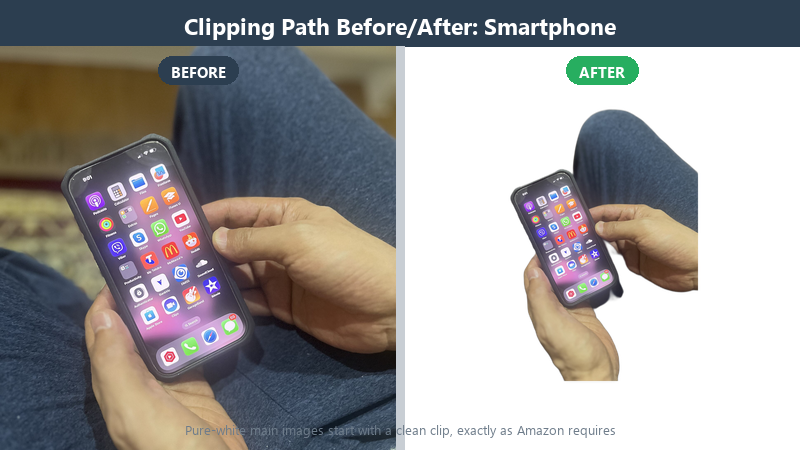
18 Nov How Clipping Path Images Boost Amazon, Shopify and eBay Conversion Rates
How Clipping Path Images Boost Amazon, Shopify and eBay Conversion Rates
On Amazon, Shopify, and eBay, your product image doesn’t just show what you’re selling — it decides whether the shopper clicks “Add to Cart” or keeps scrolling. A clean, professionally clipped product image builds trust in seconds. A sloppy one destroys it.
Here’s how clipping path images directly impact conversion rates across the three biggest marketplaces.
Amazon: White Background Isn’t Optional
Amazon’s main image requirement is strict: pure white background (RGB 255,255,255), product fills 85% of the frame, no props, no text, no watermarks. A clipping path gets you there — but only if it’s done right.
A halo around your product, a jagged edge, or a gray shadow smear gets noticed instantly. Shoppers compare your main image against ten others in the search results. If yours looks pasted in, they assume the product is cheap — and they click the next listing.
A properly clipped Amazon image:
- Meets the 255 white background requirement exactly
- Shows clean, crisp edges at zoom (Amazon shoppers zoom constantly)
- Looks like it belongs on the platform, not like a DIY edit
Shopify: Brand Consistency Is Your Storefront
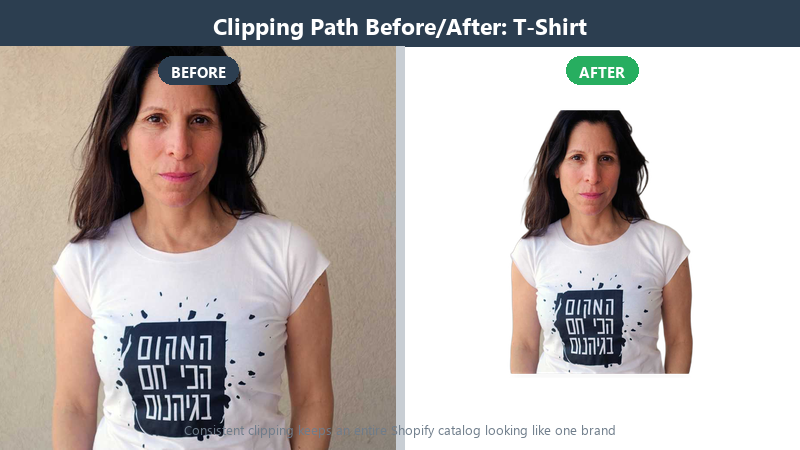
On Shopify, you control the entire experience — which means inconsistency is entirely your responsibility. If image 1 has a sharp edge and image 50 has a soft, feathery edge, your store looks disjointed. Trust evaporates.
Clipping path services solve this by working to a written image standard: same shadow angle, same white point, same edge softness across your entire catalog. When every product looks like it came from the same shoot, shoppers trust your brand — and trust converts.
eBay: Trust in a Crowded Marketplace
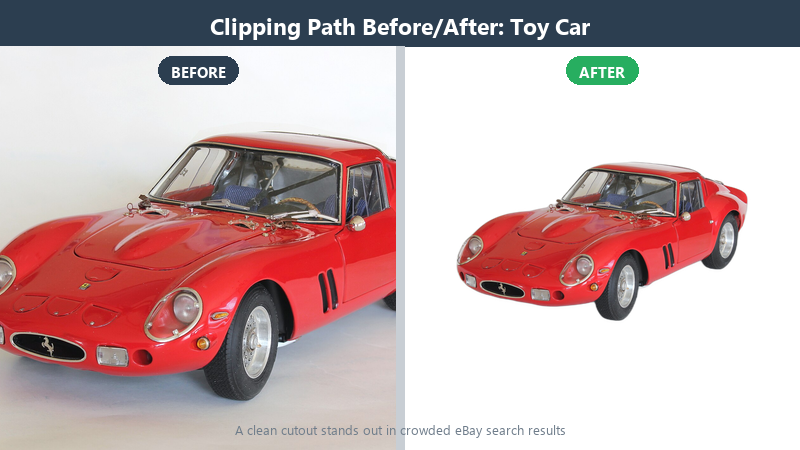
eBay shoppers browse fast. Your image competes against dozens of similar listings in seconds. A clean white background makes your product pop in search results. A cluttered background or poor cutout makes it disappear.
Clipping path images on eBay:
- Stand out in search results with a clean subject
- Support zoom and mobile viewing without falling apart
- Signal professionalism — and willingness to stand behind the product
Why Conversion Drops Without Clipping Paths
Shoppers can’t touch your product. They judge it entirely by the image. If the edge is jagged, the background ghost is visible, or the shadow looks like a smear, the shopper doesn’t think “poor Photoshop work.” They think “cheap product.”
Cheap products don’t convert. Clean, professional images do.
The Real Metric
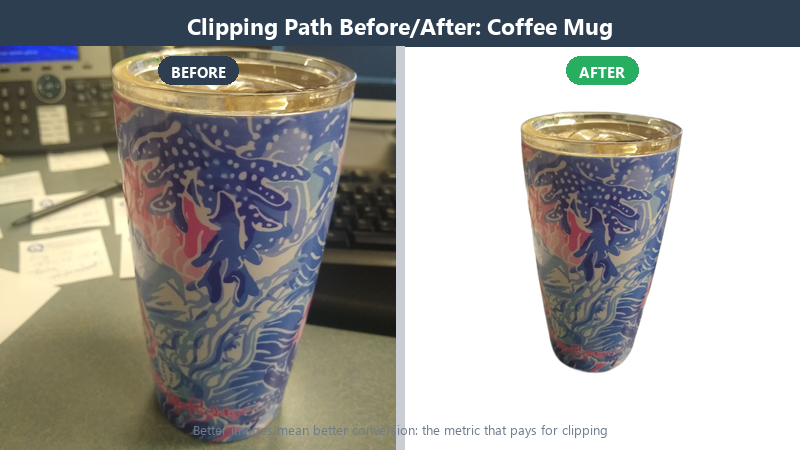
Marketplace teams track one number above all: the product images conversion rate — the share of shoppers who go from thumbnail to checkout. A cutout that lowers it was never cheap, whatever the invoice said.
The Two Numbers Platforms Watch: Click-Through and Conversion
Every marketplace funnel has a front door and a checkout. Click-through rate lives at the door: of the shoppers who see your thumbnail in search, how many tap. Conversion rate lives at the checkout: of the shoppers on your product page, how many buy. Images govern both — the main image wins the click, the gallery wins the order.
Clipping path work feeds both numbers, quietly. A clean subject on pure white reads instantly at thumbnail size, where cluttered images turn to noise. In the gallery, consistent edges, honest color, and grounded shadows answer the questions a skeptical buyer is silently asking: is this real, is this clean, do I trust this store with my card?
Platforms measure everything. Your images are the only funnel variable you fully control before the click.
Amazon’s Rules, Decoded
Amazon’s main-image requirements read like legalese until you translate them: pure white background (RGB 255,255,255), product filling at least 85% of the frame, no props, no text, no watermarks, no additional objects. That is a clipping path spec. A machine-trimmed JPEG with a near-white background can pass automated checks and still look gray next to a true-white competitor’s thumbnail — and a haloed edge can trigger suppression on strict categories.
The gallery is friendlier: A+ content, lifestyle shots, and infographics can breathe. But the same discipline applies — cut-outs inside A+ modules must sit on the module’s background, not on a rectangular ghost of their old one. Sellers who clip their full asset library once, to one spec, stop thinking about image compliance entirely. It simply stops being a ticket in the queue.
An Illustrative A/B: Same Shoe, Two Main Images
Imagine the same running shoe listed twice. Image A is the factory shot: gray studio floor, a corner of the light tent visible, laces blending into a grayish background. Image B is the same photograph clipped to true white, product filling the frame, a soft shadow grounding it.
Run that comparison honestly — as an illustrative thought experiment, not a guaranteed result — and the mechanics are predictable. At thumbnail size, B has more product per pixel and a cleaner silhouette, so it earns more taps from the same impressions. On the page, B’s zoom stays sharp where A’s background noise does, and nothing in the frame distracts from the product.
We cannot promise your percentages; nobody honest can. What we can promise is the mechanism: more product per pixel and zero background noise is the configuration every marketplace rewards.
Returns: The Conversion Metric Nobody Blames on Images
Everyone tracks returns, and everyone blames logistics. But a large slice of “not as pictured” returns begins with the picture. A color that drifted after clipping, a texture the background hid, a shadow that made a cushion look thicker than it is — each is a tiny promise the product cannot keep.
Precision clipping plus honest color correction narrows that gap. The edge you draw cleanly is the boundary the buyer trusts; the white point you match is the color they expect to open. Returns are expensive in refunds, in rankings, and in reviews that never forget. Clean images are the cheapest returns policy you will ever install.
Platform Quick-Spec Table
| Platform | Main image rule | Gallery advantage |
|---|---|---|
| Amazon | Pure white, 85% frame, no extras | A+ modules with clean cut-outs |
| Shopify | Your theme decides — consistency is on you | Lifestyle + white mix, one visual spec |
| eBay | Clean background strongly rewarded in search | Zoom-friendly detail shots |
Three platforms, three rulebooks, one constant: edges and backgrounds are where compliance is won or lost. Clip once, to the strictest spec, and every channel inherits the quality.
A 30-Minute Image Audit You Can Run Today
Before spending anything, spend half an hour measuring your own store. Open your five best-selling listings and one struggling one. For each: zoom the main image to 200% — are edges crisp or fuzzy? Check the background: pure white, or a grayish near-white that dulls the thumbnail? Count noise: props, shadows from the light tent, reflections of the photographer — anything that is not product. Compare gallery consistency: does image four look like it belongs to the same store as image one? Then open your top competitor’s listing beside yours at thumbnail size and ask the only honest question: which one would you click?
Write down what you find per listing — three bullets each. Most stores discover the same pattern: the main images are passable, the gallery drifts, and the competitor wins the thumbnail fight on background purity alone. That list is your editing brief. Send it with your next trial batch, and you will be fixing measured problems rather than imagined ones — which is also how you will know, in the numbers, whether the work paid.
Mobile: Where Your Clipping Work Is Actually Judged
Most marketplace browsing happens on a phone, which changes what “clean” means. At mobile thumbnail scale, background clutter turns to mud, thin text becomes noise, and a soft edge reads as a fuzzy halo. The images that win the tap are the ones with maximum product per pixel and nothing else in the frame. Zoom behavior matters too: shoppers pinch-out on details — stitching, grain, hardware — so the edge quality you verified at 200% on desktop is exactly what mobile buyers inspect first. The practical takeaway: review your main images at phone size before publishing. If the subject pops off the white instantly at a glance, your clipping investment is doing its job where most of your buyers live.
Where This Shows Up in Your Numbers
Your marketplace images are your salespeople. Clipping path services make them look professional, trustworthy, and ready to convert.
Before your next listing push, send us two images. Put our clipped versions next to your current ones — the click-through difference is usually obvious within days.

No Comments