
21 Nov Clipping Path for Jewelry, Fashion and Glass: Handling Transparent and Reflective Products
Clipping Path for Jewelry, Fashion and Glass: Handling Transparent and Reflective Products
Some products are easy to clip: a box, a bottle, a shoe with hard edges. Then there are the hard ones — jewelry with tiny prongs, fashion with sheer fabric and flying hair, glassware with reflections and refractions. These don’t respond to simple clipping paths or AI background removal. They require specialized masking techniques.
Here’s how professional clipping path services handle the most difficult product categories.
Jewelry: The Prong Problem
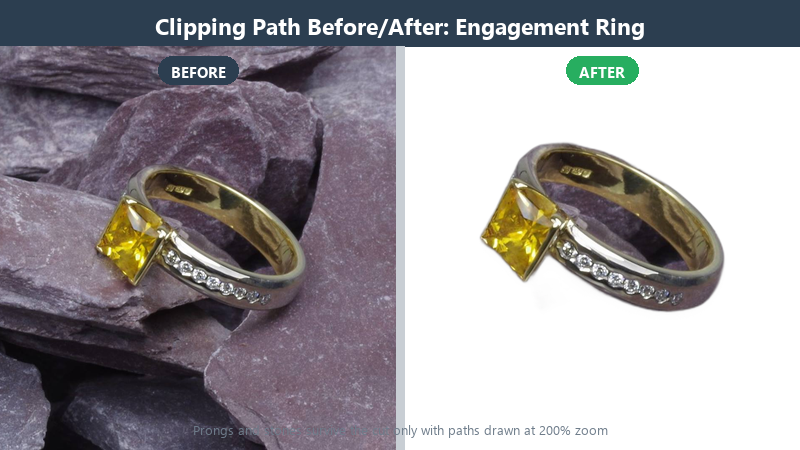
Jewelry is the ultimate test of clipping path skill. Rings have thin metal bands, delicate prongs holding stones, and intricate filigree. A simple path rounds off corners, eats prongs, or softens details that define the piece’s value.
Professional jewelry clipping uses:
- Paths drawn tightly around every prong and edge, at 300%+ zoom
- Channel-based masking for transparent gemstones
- Careful shadow work so the piece looks like it’s resting on a surface, not floating
When the edge is wrong, the jewelry looks cheap. When it’s right, every detail sells the piece.
Fashion: Hair, Fur, and Sheer Fabric
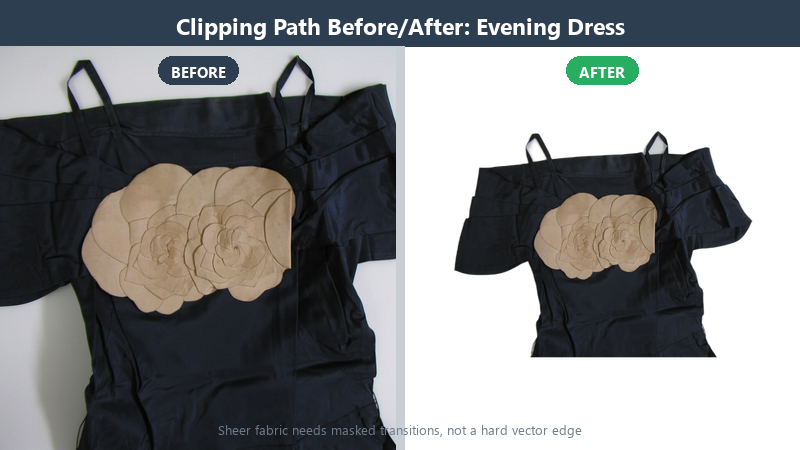
Fashion photography involves moving subjects — models with flying hair, fur coats, sheer dresses, lace details. A single hard vector path cannot capture these. The result looks like a cardboard cutout.
Professional fashion clipping combines:
- Multiple clipping paths for hard edges (clothing outlines, accessories)
- Channel-based masking for hair, fur, and sheer fabric
- Hand-painted transitions so strands and fibers survive the cut
- Soft edges where fabric meets background, preserving texture
AI tools fail here constantly — they eat hair strands, turn sheer fabric opaque, and create plastic-looking edges. Hand masking doesn’t.
Glass: Reflections and Refractions
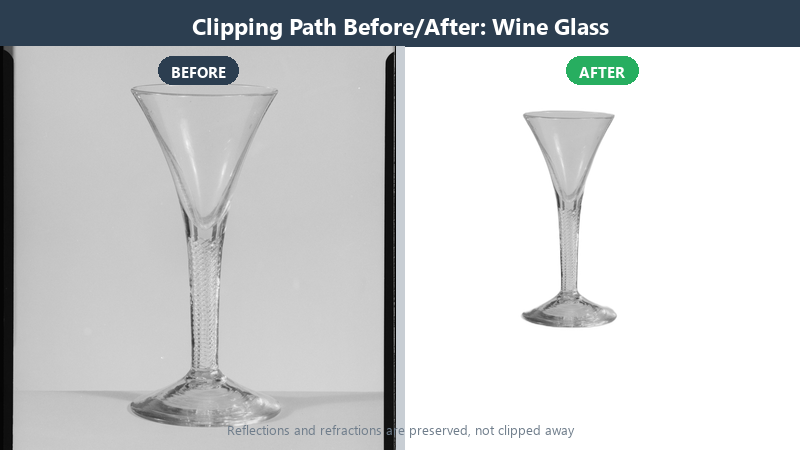
Glassware is difficult because it’s simultaneously transparent and reflective. You see through the glass, but you also see reflections on its surface. A standard clipping path either cuts away the reflections (making the glass look flat) or leaves background clutter around it.
Professional glass clipping uses:
- Multiple paths for different parts of the glass (rim, body, base)
- Masking that preserves reflections and refractions
- Drop shadows that match the light source
- Careful edge work so the glass looks solid, not cut out poorly
Why Automation Fails These Categories
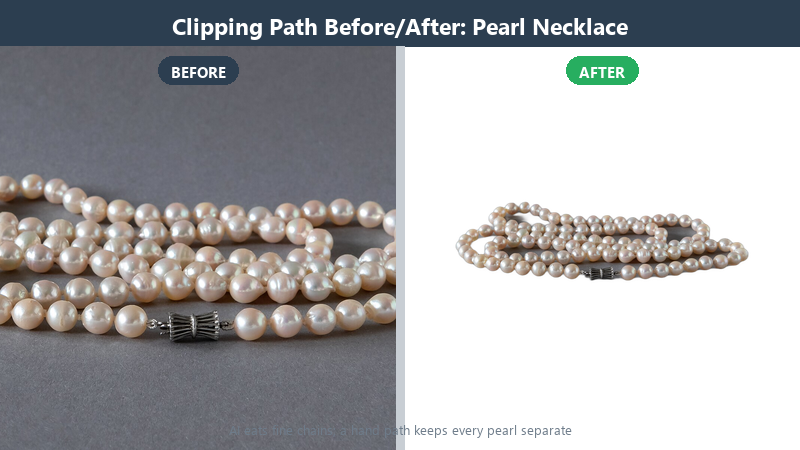
AI background removal looks for contrast — where the product ends and background begins. Jewelry prongs, sheer fabric, and glass reflections have low or ambiguous contrast. The AI guesses wrong. The result is eaten edges, halos, and transparent areas that shouldn’t be transparent.
A human editor understands materials. They know what should stay and what should go.
Jewelry: The Prong-by-Prong Pass
A ring is not one subject; it is a hundred small subjects voting on where the edge goes. Professional jewelry clipping starts at 400% zoom with a map: every prong, every facet junction, every millimeter of filigree gets its own decision. Stones are the hard part — their facets are made of reflections of things that are not the stone, and cutting by contrast deletes exactly the sparkle the product exists for.
The discipline is to keep the reflection diet honest: keep highlights that describe the metal’s form, remove slivers of the studio that happened to sneak in. Chains add a final test — a tennis necklace at high resolution is hundreds of near-touching links, and a lazy path welds them into a ribbon.
Done right, nothing about the result says “edited.” The piece simply looks like itself, on white, at any size the buyer zooms to.
Fashion: When the Fabric Is the Product
Clothing punishes hard edges because fabric IS soft edges. A sheer sleeve shows the background through two layers of chiffon; cutting it with a single path produces a sticker, so the job becomes a double mask — one for the garment, one for the transparency — blended by hand where the layers overlap skin. Fur refuses boundaries altogether: the outline is a cloud, and the transition is painted strand by strand until the zoom test passes.
Sequins bring their own mischief — each disc is a tiny mirror, and half the frame’s sparkle lives in highlights that a contrast-based cut would erase. And wrinkles deserve respect: an over-eager editor who smooths creases in the name of cleanliness is lying about the product the buyer will receive.
The fashion rule our maskers work by: preserve texture, preserve movement, preserve truth. Everything else is negotiable.
Glass: Keep the Liquid, Lose the Smudge
Glassware is a paradox in a frame: the subject is mostly what you can see through it. The edges of a wine glass are not surfaces but refractions — bright lines where the curve bends light — and the liquid inside has its own edge, its own meniscus, its own color shift. A competent glass clip keeps the refraction rim, the liquid line, and the label as three separate decisions, because a single path flattens all three into plastic.
Fingerprints and dust are the editor’s to remove; caustics — the bright pools light throws through the glass onto the surface — are the editor’s to reconstruct when the background changes. Get both right and the glass reads as crystal on any backdrop. Get either wrong and no amount of marketing saves the listing.
This is why we say glass is built, not cut. The path is the beginning of the job, not the end.
Photography Choices That Make Hard Clipping Cheaper
Here is an uncomfortable, money-saving truth: the cost of a difficult clip is often decided at the shoot. A pure white or uniform sweep behind a crystal vase turns a complex job into a moderate one. A polarizing filter knocks glare off chrome before an editor has to fight it pixel by pixel. Focus stacking a macro ring shot gives the editor a sharp prong to follow instead of a soft suggestion. Moving props three inches farther from the product keeps their shadows out of the silhouette.
None of this requires a bigger studio budget — it requires the photographer and the editing team to talk before the shoot, not after the invoice. Send your editor a shot list; ask what the frame needs to clip cleanly. A five-minute call routinely saves twenty percent of the editing bill, and the images come back better than the brief asked for.
Turnaround Reality for Hard Categories
Straightforward clipping is measured in minutes; hair, fur and glass are measured in quarter-hours and up, and the difference is honest, not padded. A flying-hair model shot can take longer than the photoshoot did. Rushing it does not make it faster — it makes it twice, because the QC bounce sends it back to the same desk with the same problems.
So when you plan a hard-category launch, ask your provider for a realistic SLA per category, not a single number for the catalog. The professional answer will have tiers, and the tiers will differ. Our own floor runs 24/7 shifts precisely so that the complex work — the slow, careful kind — still clears a 24-hour clock when a launch demands it.
Speed is a feature. But for jewelry, fashion and glass, it is a feature built out of patience.
Three Questions to Ask Before You Send Hard Products
Before trusting a provider with your jewelry line or your glassware, ask for proof in three specific forms. One: “Show me a glass product at 400% zoom, edge intact, liquid line preserved” — screenshots crop nicely, so ask for the full frame with the file open. Two: “Walk me through your sheer-fabric approach” — the correct answer mentions multiple masks and hand-painted transitions, not one magic button. Three: “What is your realistic turnaround for my hardest category, per image?” — vague answers here predict missed launches later.
Notice all three questions can be answered in a single email with attachments. A provider who replies with evidence within a day is telling you how every future ambiguity will be handled. One who replies with adjectives is telling you that, too.
When the Ordinary Path Isn’t Enough
Jewelry, fashion, and glass don’t forgive bad clipping paths. These products demand hand-drawn paths, channel masking, and constructed shadows — the kind of work that only experienced clipping path services deliver.
Send the product you’ve been told can’t be clipped well — the filigree ring, the sheer sleeve, the crystal glass. That’s exactly what the free trial is for.

No Comments