
22 Nov Why AI Background Removal Still Can’t Beat a Handmade Clipping Path ?
Why AI Background Removal Still Can’t Beat a Handmade Clipping Path
Every few months, a new AI background removal tool launches with promises to put clipping path services out of business. Upload your photo, click a button, get a cutout. It’s fast, it’s free or cheap, and it’s getting better. But after fifteen years of fixing what automation produces, I can tell you exactly where it still breaks. The debate — AI background removal vs clipping path — is really a question about which jobs each method can be trusted with — and why e-commerce sellers keep coming back to the pen tool.
1. Automation Struggles With Ambiguity
An AI looking for “the product” cannot tell that the thin plastic wrap around a garment is part of the product and not background. It cannot tell that a wisp of hair crossing a model’s cheek should survive. It cannot tell that a white shirt on a white background needs an edge drawn from shadow and texture rather than contrast.
A human doing clipping path work can — because a human understands what the item is.
2. Automation Has No Brand Standard
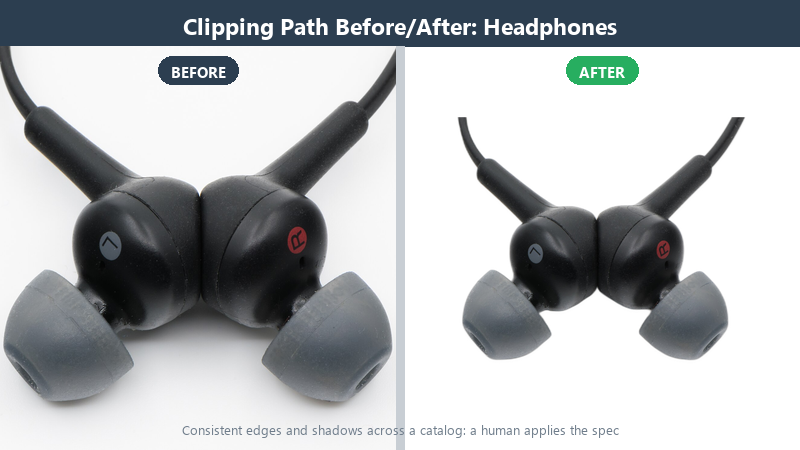
A catalog needs consistency: the same shadow angle, the same white point, the same edge softness on image 1 and image 900. Automated output varies with every input. A person working to a written spec does not. When your marketplace listing has fifty product images, inconsistency looks amateur.
3. Automation Cannot Correct Itself
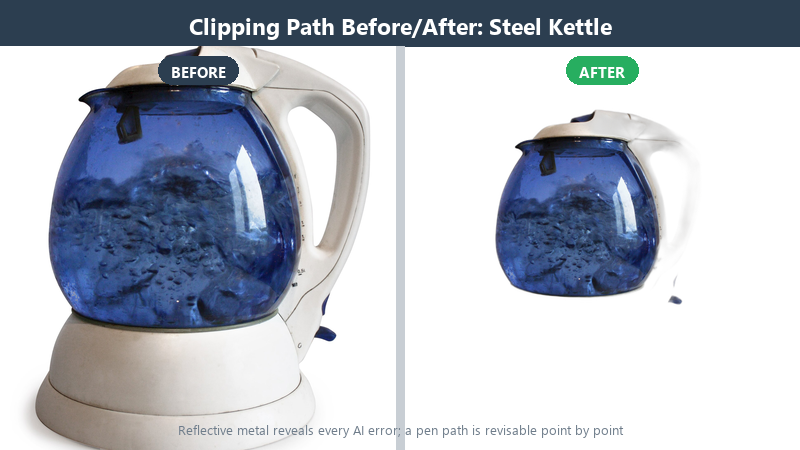
When an automated cut-out is wrong — halos, eaten edges, missing transparency — it’s wrong in ways that are hard to fix. You can’t edit an algorithm’s guess. A clipping path is editable. Every anchor point is a decision, and every decision can be revised. Move a point, soften an edge, rebuild a shadow — the file stays flexible.
4. Some Things Aren’t Cut-Outs at All
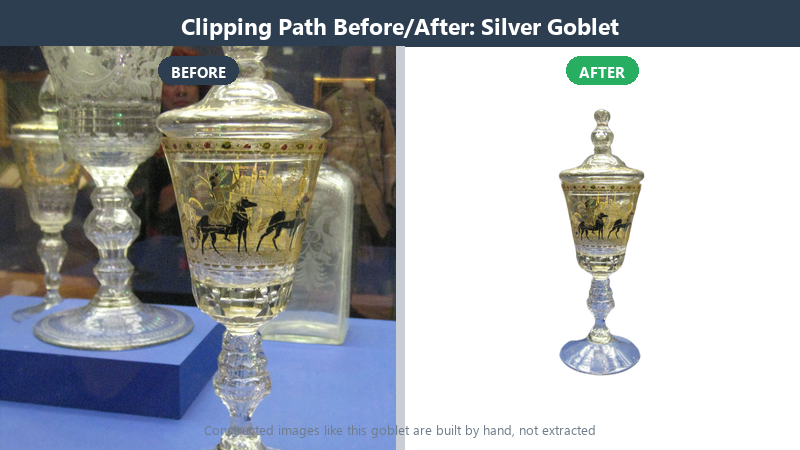
Ghost mannequin work, complex masking for flying hair, reflection shadows for glass — these are constructed, not extracted. No “remove background” button produces them. They require an editor who understands light, dimension, and materials.
5. The Hidden Cost of “Free”
A $0.10 AI cutout that needs two rounds of revisions and a shadow reshoot costs more than a $0.40 hand-clipped image that arrives correct. Cheap work is only cheap if it doesn’t come back.
Where AI Belongs
We’re not anti-AI. Automated tools are excellent for simple, high-contrast, high-volume work. For everything that requires interpretation, brand consistency, or a constructed shadow — a human hand on the pen tool is still the most reliable way to make a product look convincing.
Four Images That Defeat Automation — Every Time
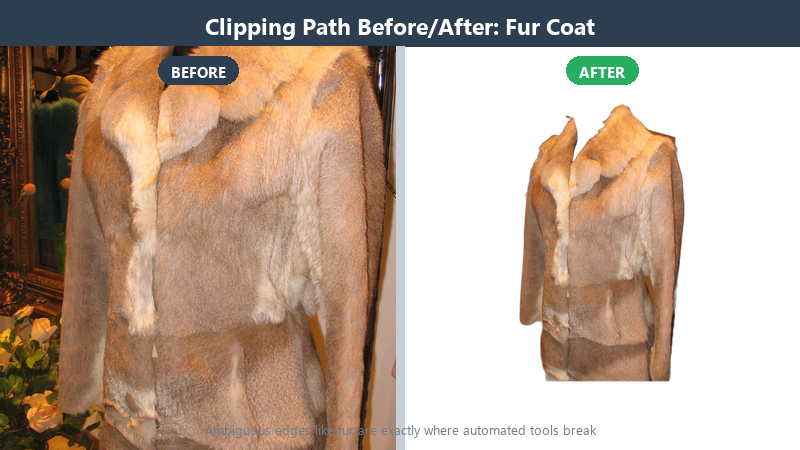
The fur coat. The machine sees a fuzzy boundary and does its best approximation: a hard-ish edge with the wisps either eaten or haloed. A human paints the transition strand by strand, because the buyer’s eye will count those strands at zoom.
The white shirt on a white sweep. There is no contrast to find, so the tool either erases the shirt or keeps the background. An editor reads the edge from shadow and fabric texture — information the machine has no concept for.
The glass perfume bottle. Half the product is refraction. Cut by contrast, the bottle loses its liquid line and turns into a sticker. Kept by hand, the reflections survive and the glass stays glass.
The garment in shrink-wrap. Is the plastic packaging or product? The algorithm must guess; the editor just knows. These four are not edge cases we invent — they are Tuesday.
Why the Machine Guesses: A Plain-Language Look
Background-removal models are trained to classify every pixel as “subject” or “not subject,” mostly by spotting contrast. When the boundary is crisp — a red shoe on white — they are astonishing. When the boundary is defined by meaning rather than contrast, they have nothing to hold on to.
The model does not know what a shoelace is. It knows that this region looks statistically like things labeled “product” in training. Thin, translucent, reflective, or low-contrast regions sit right at the decision threshold, which is why failures look like confidence: a smooth, decisive, wrong edge. And because the output is flattened pixels, there is nothing to negotiate with afterward — no points, no handles, no second opinion.
That is the structural gap, and no amount of training data fully closes it, because the missing ingredient is not data. It is understanding.
Machine or Human? A Quick Decision Table
| Your image situation | Route it to |
|---|---|
| Hard-edged product on a plain studio background | Automation — or a fast simple path, both fine |
| Fur, hair, feather, sheer fabric | Human masking, always |
| White-on-white or tone-on-tone product | Human — the edge lives in shadow, not contrast |
| Glass, liquids, chrome, jewelry | Human, with constructed reflections |
| 500+ images that must look identical | Human work to a written spec, with automated triage |
| Internal mockups and low-stakes drafts | Automation, happily |
If your catalog fits the first row, thank the engineers and move on. The moment it touches the middle rows, the calculator in your head should switch from “per image” to “per sale.”
What Editability Saves You in Month Six
Here is the scenario that sells hand work better than any argument: it is month six, your brand team refreshes the look, and now every product image needs a softer shadow angled from the left. If your images were hand-clipped, the paths are still in the files. An editor opens each one, adjusts the shadow layer, re-exports. The geometry — the expensive part — is untouched.
If your images were flattened by automation, there is nothing to adjust. Every single file is a redo: re-run, re-inspect, re-fix the ones the machine mangled again. The “free” cutouts get re-bought, and the redo bill lands exactly when your team is busiest with the relaunch.
Editability is not a technical nicety. It is the difference between updating a catalog and rebuilding one.
The Verdict We Actually Give Clients
When a client asks us point-blank whether they need us, we give them the same honest answer we give here. If your products are hard-edged, shot clean, and headed to channels that forgive variation, buy the automation and spend the savings on photography. If any part of your line is fur, glass, metal, white-on-white, or brand-critical, then a human path is not a luxury — it is the cheapest insurance your images will ever buy.
Most catalogs, in our experience, are both. Which is why the smartest teams we work with do not choose. They sort.
The Cost Curve: Where Automation Improves Every Year — and Where It Won’t
Fairness demands a prediction, so here is ours. Automation will keep winning on the easy end: better thumbnails of simple products, faster previews, fewer missed boxes. Every model generation shaves seconds off the jobs that were already nearly solved. If your catalog lives entirely in that world, your costs trend toward zero, and that is genuinely wonderful.
The middle of the curve moves slower than the marketing suggests, because the hard problems are not contrast problems — they are semantic ones. Whether shrink-wrap belongs to the product, whether a wisp of hair matters, whether a reflection describes glass or background: these require knowing what things are, and that knowledge does not fall out of more pixels. We expect the gap to persist not because engineers are failing, but because the missing ingredient is understanding, not data.
So plan for a future where the easy end is free and the meaningful end is human. Budgets that assume both ends converge on zero keep being surprised. Budgets that split the work keep converting.
The Honest Answer
We do not run automated tools on our own floor even for the simple clipping path jobs. Everything described above as ‘breaks’ is what our senior editors in Khulna fix by hand, every day.
AI removes backgrounds. Clipping path services sell products. For e-commerce, where the photograph is the product, that difference matters.
Want proof? Send two images — one easy, one impossible. We’ll clip both free, and you can decide which side of the line your catalog sits on.

No Comments